
Video by: gideonstactical
Knife on deck: Gerber LMF II Survival Knife
This really hunky knife you’re drooling over right now is the Gerber LMF II Survival Knife. It’s a 10-inch knife that weighs 11.5 ounces. The drop point blade is 4.84 inches long, partially serrated, and made out of 420HC stainless steel.
The LMF II’s handle is made out of glass-filled nylon with TPV overmold; it has lanyard holes that allow it to be easily converted into a spear. One of the unique things about the LMF II (whether you’re talking about the Infantry model, the ASEK one, or this one) is that it has a pointed buttcap that can be used as a hammer or a glass breaker AND it’s physically separated from the tang in order to provide shock absorption and protection from electrocution.

Sounds all good, right? Well, it gets better. The LMF II comes with a really great sheath that has 3 retention points making it ready for action. It comes with several types of lashings so it can be attached to the lower leg, the thigh, the belt, a vest/jacket, etc. The sheath is fire resistant which is also great.
The best thing about this sheath, though, is its built-in sharpener. You don’t have to worry about bringing one around with you any time you go out in the field because it’s always with you whenever you carry this knife.
So, it seems that on the surface, the LMF II has everything going for it. As you can see in the beginning of the video, gideonstactical is pretty ecstatic about the features of the knife as well. But how well does it perform in the field?
It’s pretty heavy so while that could be a point against the knife, the other good features of the Gerber LMF II seem to cancel out any negatives the weight might pit against it. Before I digress any further though, let’s talk about how this hunk of steel “survives” in the wild.
FIELD TESTS
Detail Work
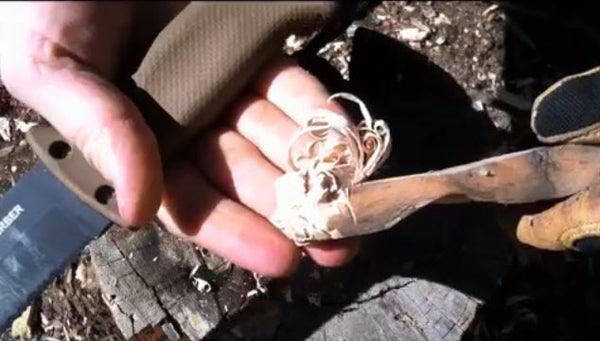
#1: The LMF II does perform well when doing detail work whether using the plain edge part of the blade or the serrated part. The shavings are almost paper thin. The handle of the knife fits the hand perfectly, providing the firm grip needed when exerting the level of control this kind of task requires.
Prying, Stabbing, (and Digging)
#2: The tip of the Gerber LMF II blade is extremely strong. It can be used to pry open almost anything open, which might be necessary since a crowbar isn't something that generally goes into a survival kit or camping gear.

The Gerber LMF II can also be used as a shovel if necessary, and it will definitely perform really, really well. While these kinds of tasks are not something you’ll generally be doing with this knife, knowing that the blade is able to withstand this kind of stress will be a comfort in a survival situation even if it is the only tool available.
Wood-processing Tasks
#3: For an almost 5-inch blade, the LMF II is quite a decent chopper. Gideonstactical gives it a grade of light to medium chopping. It isn’t the most ideal or the best one in the market but it will do in a pinch. This, of course, is one of those instances where the weight of the blade is a PRO because heavier weight definitely makes this kind of task easier. And while chopping might not be its forte, the knife can take a beating (as you can see in the video) without losing its edge. It can definitely be used in various wood processing tasks such as hacking and batoning (which the knife can do up to a point), and still remain sharp.
WHY WE LIKE GERBER'S LMF II SURVIVAL KNIFE
The LMF II is an extremely sturdy knife with an incredibly strong tip. The blade is thick and retains its edge really well. The buttcap is really unique and the weight is not as bad as most would think. While the handle could be sturdier (as evidenced in the video), it does give a firm, comfortable grip. And let’s not forget that the LMF II’s sheath might just be one of the greatest sheaths out there. Overall, it’s not a perfect knife but it comes pretty close.
View Gerber LMF II on Amazon!
드라이브인랙 안전관리
물류창고와 제조공장에서는 적재량뿐 아니라 작업자가 제품을 얼마나 빠르고 안전하게 다룰 수 있는지가 중요합니다.
드라이브인랙의 핵심은 통로 수를 줄여 동일 면적에서 많은 팔레트를 보관할 수 있다는 점입니다. 제품을 무작정 많이 적재하기보다 입출고 빈도와 작업 방식에 맞춰 구조를 정해야 합니다.
특히 드라이브인랙 안전관리과 관련해서는 현장의 보관 품목과 작업 빈도를 먼저 파악해야 합니다. 같은 드라이브인랙이라도 가벼운 제품을 소량 보관하는 곳과 무거운 제품을 반복적으로 입출고하는 곳의 설계는 달라질 수 있습니다. 통로를 지나치게 좁게 잡거나 허용 하중을 정확히 표시하지 않으면 작업 효율이 떨어질 뿐 아니라 안전사고 위험도 커질 수 있습니다.
설비 정보를 확인할 때는 드라이브인랙의 기본 구조뿐 아니라 설치 후 유지관리 방법도 함께 살펴보는 것이 좋습니다. 기둥과 연결 부위의 변형, 볼트 풀림, 바닥 고정 상태, 작업 장비의 충돌 흔적 등을 정기적으로 점검하면 작은 손상이 큰 사고로 이어지는 것을 예방할 수 있습니다.
드라이브인랙을(를) 효율적으로 활용하려면 창고 전체를 하나의 시스템으로 봐야 합니다. 제품의 입고 위치, 보관 순서, 출고 방향, 작업자의 이동 경로를 함께 고려하면 불필요한 이동을 줄이고 재고 관리도 더 체계적으로 할 수 있습니다.
현장에 맞는 설계를 적용하면 보관 공간을 효율적으로 사용하면서 작업 안전성도 함께 높일 수 있습니다.
드라이브인랙 안전관리
파렛트랙
중이층
중량랙
경량랙
하이랙
드라이브인랙
슬라이딩랙
금형랙
암랙